AZADE VAKILI

Indeed Flex is a mobile platform that connects job seekers with temporary work opportunities that fit their lifestyles. It offers a fast, flexible way to find shifts, giving workers ownership, control, and choice over where, when, and how they work.
MY ROLE
UX/ UI Designer
PLATFORM
iOS/ Android app
TIME
6 Month
YEAR
2024-2025
CONTRIBUTION
DELIVERABLES
-
Ideation
-
Competitive analysis
-
User flow, Sketching
-
Wireframes
-
Interaction design
-
Mapped user journey from application to AI interview completion
-
Designed low- and high-fidelity prototypes for the interview flow
-
Defined conversational interaction patterns and accessibility standards
-
Collaborated with product, engineering, and AI teams to align requirements
-
Conducted usability testing and iterated based on candidate feedback
-
Delivered annotated final designs for developer handoff
PROJECT OVERVIEW
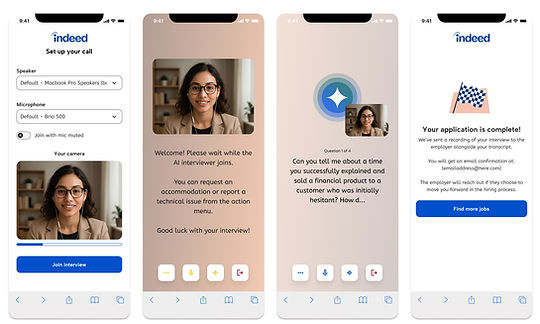
The AI Interview feature was introduced to Indeed Flex to streamline the hiring process for temporary roles by allowing candidates to complete an automated interview directly within the app. Using AI-driven prompts and evaluations, the feature aimed to provide employers with consistent, objective insights while enabling candidates to move through screening faster and more conveniently. This addition integrated seamlessly into the existing application flow, reducing approval times and improving the overall user experience for both job seekers and hiring managers.


RESEARCH & INSIGHTS
Research for the AI Interview feature included competitor analysis, user interviews, and review of existing hiring data to identify bottlenecks in the screening process. Insights showed that candidates valued speed and clarity, while employers needed consistent and reliable assessments. These findings shaped the feature’s design to balance efficiency with a supportive user experience.


IDEATION& INTERFACE DESIGN
With an established design system in place, the ideation process focused on rapidly exploring concepts directly in high-fidelity. Using existing components, I created interactive prototypes to test different entry points, question formats, and feedback methods for the AI Interview. Close collaboration with product managers, engineers, and the AI team ensured each concept aligned with technical requirements while delivering a clear, supportive experience for candidates.


DESIGNING ACCESSIBLE AI INTERVIEW
AI-led interviews can create additional barriers for candidates who require accessibility accommodations. To ensure the interview experience remains inclusive, I designed a system that allows candidates to request reasonable accommodations during the interview process without interrupting the flow.

DIALOGUE PATTERN DESIGN
To make the AI interview feel closer to a real conversation, I designed a structured dialogue pattern that allows the system to adapt based on candidate responses rather than following a rigid question list.
Conversation Flow
1. AI asks a core question
The interview begins with a structured question related to the role.
2. Candidate responds
The system captures and analyzes the candidate’s answer.
3. AI evaluates the response
The AI identifies key signals such as experience, clarity, and relevance.
4. AI decides the next action

USER TESTING
During testing, we focused on evaluating both the visual and interactive elements of the AI Interviewer. Participants were asked to navigate the interface while paying attention to the visual hierarchy, including size ratios, icons, and speech bubbles, ensuring each element was easily distinguishable and intuitive. I observed how users responded to the flow of interactions and whether the AI interview prompts were clear and actionable. Feedback was collected on both micro‑interactions and overall usability, guiding refinements in interaction design to create a seamless, engaging, and visually coherent experience.


WHAT I LEARNED
• AI experiences require trust and transparency
Candidates need clear guidance on how the system works and how responses are evaluated.
• Conversational interactions improve usability
Adaptive follow-up questions help candidates explain their experience more naturally than static prompts.
• AI works best as decision support
AI can analyze responses and surface insights quickly, helping recruiters make more informed decisions.
• Systems thinking is critical
The experience goes beyond the interview interface to how responses are captured, analyzed, and presented for evaluation.